Mythic

~  IN PIECES

1. HADES, WAITING

He stood, eyes to the sea, watching
the waves marbleize into
savages on the sand.
Trying to see through her eyes…
in metaphor and something beyond.

“In the moments that make an impression —
the bank of fog rolling in, for instance,
the marine layer that’s clouding out the
sun moves inland trying to capture
an echo of the flying Icarus
before his wings melt;” — she’d once said.
“A replica of the original
when the original has been taken,
or was never given…
Something has been lost.

“The grey scale against the swallow of
tides and salty air dissolves sea into sky
until the wall of wet confronts
a father’s palms.
Palms cupping leftover feathers
and loss. The mists were too late.
The escape so palpable,
so final.

“To love a thing too much
defies eternity,”— she’d added.
“Something is always lost
in the metaphors of sun and flame
and feathers.”

It was not the father [feathers] of
a lost Icarus he was trying to grasp,
but her.
He captured her memory that way —
in metaphor. It was the only thing
standing between himself
and the eternal sum of her.

He knew her though. The way
she infused meaning into the moment.
And she had, at one time or another,
known him.
Known his habits,
the way he ground his knuckles into
his lips, his thumbs
cupping his chin in thought.
She, so quiet behind him,
setting her chin on her hands on his head
and looking down to watch him deliver
equations one to another,
a copulation of calculated expressions.

He’d exalted in her presence.
She asked only how he viewed the world,
in numbers or hypotheses of souls,
maybe in definitions of words
rooted in something more articulate
than language.
At that he’d opened wide his eyes and turned
to her. “All those words,” he’d said.
“Nebulous, subjective at best.”
And she laughed her laugh of antique
dignity. The one he missed most.
“Maybe,” she’d said, nourishing his
dark humor.

But that’s all he could lay claim to —
her fingers on his pulse.
This sea-staring, Icarus-dare
he hoped, might clarify her nebula,
or fuse it, at least, with the white heat
of her absence.

She became more to him when the sea
stood against the dark night,
when they were hovering on the smooth,
shiny wood of the pier looking down, down
together through the black,
silent waters, the only voice,
the voice of the deep and unseen.
Sometimes shivering, she huddled
into him, his arm around her
siphoning out his warmth;
both of them made bold
with a new heat. Maybe that’s
what he missed most,
the split nerve of the quiet hour
when pomegranate pips burst open
on her tongue, and she is his again.
At least, for a while.

2. PERSEPHONE, BOLD

Story goes I was stolen
amid a field of blood-red peonies,
each one open, ripe for the ripping.
(Or was that me?)

Anymore, the thing they call me is legend,
a prop for a god’s inhumanity.
But I fell in love.
You know this.
(Sh.)
If Mother knew,
she’d kill the year instead of just
the seasons.

The inhibited say your name means death,
the otherworld for
the cursed, the damned,
the God-rejecters.
They forget the Elysian Fields
and have never seen you.

Your dark-throated beauty unseeded me
more than your pomegranate pips, —
the lull of dangerous delicacies
ripe for the ripping.

It terrified me, the thought of you
not hearing me
amid the tumbled swords of legend
that might leave me drifting
soundless among the words
of a thousand other myths.
Lost in foreign tongues that
misunderstand the heart.

But you knew
even if no one else did.
It was me that chose.
That swallowed the pips
and sealed half a life of lies,
the other half
buried with you
beneath Avernus
in the dark caves that suck the
breath of birds.

Fairytale endings happen, they say.
To others.
For me, the gemini-hearted twilight
sinks a summer sun,
and I am gone,
gone to the waiting arms
of you, my Love, who holds the power
of death if not life in your dark embrace.

And, in the temporal death of the earth,
I am, for a time, against the propagation
of misinterpreted myth, free.

©2010–2025: Zoëtrope in Words. All rights reserved.
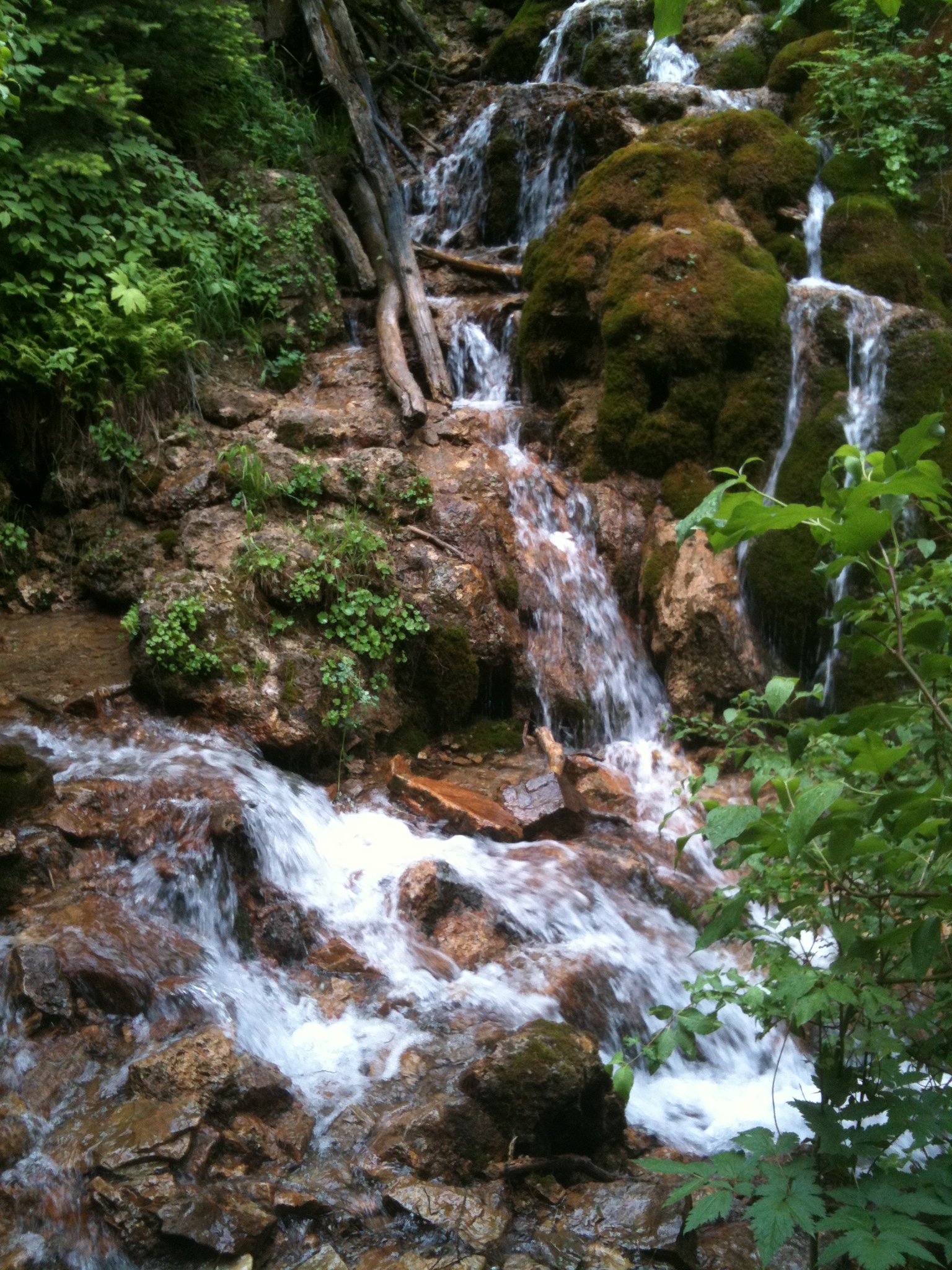
In the shadows of mountains and fairytales…

“Fairy tales are more than true: not because they tell us that dragons exist, but because they tell us that dragons can be beaten.” ~ NG [a disregarded man]

on the hanging lake trail
I grew up playing in the wrinkles of the Rocky Mountains.

On winter ski lifts, the fierce contrast framed snow against evergreens as far as I could see, my lips frozen beyond speech.

In summer, rugged sun-spangled cliffs, slashed by falling rivers and velvet moss, danced in the light.

Too many times I hung over the rushing creek dangling my shoes from the thick branch that offered me a place to sit and memorize the earth, the clouds, the whirling worlds alive before my eyes and below my feet. Till one time my shoe leapt into the froth below. What was a girl to do? Kick the other one in to join its mate. Having ridiculously tender footsoles, I hobbled painfully home never regretting my loss.

Now, the remembrance of the footpath, the tree, the bridge over the wide creek throws me into clarity. And fairytales become real again. Dragons can be conquered, but I have to remember that.

Earlier than NG [the disregarded man], G.K. Chesterton took it deeper. He said, “Fairy tales, then, are not responsible for producing in children fear, or any of the shapes of fear; fairy tales do not give the child the idea of the evil or the ugly; that is in the child already, because it is in the world already. Fairy tales do not give the child his first idea of bogey. What fairy tales give the child is his first clear idea of the possible defeat of bogey….”

I didn’t get to read fairytales until I was old enough to read for myself. I didn’t have access to them until I was out of grade-school. (Maybe that’s why the bogeyman wouldn’t ever go away.) By then, I considered myself too mature for them. Finally, I grew old enough again to read them.  Beginning with Shel Silverstein’s ‘The Giving Tree’, like a pent-up wind released, they gave my imagination somewhere to go.

Then, I wanted to waste nothing in the making of tales. Poetry came first. I never thought I’d be able to commit to a novel, even though it ran through my brain over and over. Poetry is a quick glance, a smile, a nod, an embrace and then you’re done. Maybe a re-visit here and there to tweak it. But a novel, now that’s a marriage. Too many novels turn pretentious at some point, woody at others, and the risk to make every single word draw the story out seemed so daunting. When I read “Fugitive Pieces” by Anne Michaels, I knew I had to at least try.

Anne said in an interview, “You spend your time when you’re writing erasing yourself. The idea is to get out of the way of it.”

I knew I could do that…get myself out of the way.

About poetry, she said:
“…it’s such a good discipline for a novelist: it makes you aware that even if you have four or five hundred pages to play with, you mustn’t waste a single word.”

Since poetry’s my practice, this, too, seemed possible. I was aching to try. In the folds of life, word by word, ‘Delicate‘ winked its way out. Part gothic, part myth, history, love and revenge, it’s a fairytale that brushes against the mystic. (But isn’t that the nature of all fairytales?😉)Gryphon

“I Knew You Were Waiting” ~ Aretha and George

©2010–2025: Zoëtrope in Words. All rights reserved.

Malignant worlds of wonder…

~ J.G. Ballard.

Is there anyone like him?

Original, imaginative, his work sets its own parameters. Stark, it builds in story and description then slams itself into you like a force of its own nature.

“The Complete Stories of J.G. Ballard” begins with seeming simplicity, but grows intense fast. A tremendous introduction to Ballard’s work.

For example, from “The Garden of Time”:

“Towards evening, when the great shadow of the Palladian villa filled the terrace, Count Axel left his library and walked down the wide marble steps among the time flowers. A tall, imperious figure in a black velvet jacket, a gold tie-pin glinting below his George V beard, cane held stiffly in a white-gloved hand, he surveyed the exquisite crystal flowers without emotion, listening to the sounds of his wife’s harpsichord, as she played a Mozart rondo in the music room, echo and vibrate through the translucent petals.

“As was his custom before beginning his regular evening stroll, Count Axel looked out across the plain to the final rise, where the horizon was illuminated like a distant stage by the fading sun. As the Mozart chimed delicately around him, flowing from his wife‟s graceful hands, he saw that the advance columns of an enormous army were moving slowly over the horizon. At first glance, the long ranks seemed to be progressing in orderly lines, but on closer inspection, it was apparent that, like the obscured detail of a Goya landscape, the army was composed of a vast confused throng of people, men and women, interspersed with a few soldiers in ragged uniforms, pressing forward in a disorganised tide. Some laboured under heavy loads suspended from crude yokes around their necks; others struggled with cumbersome wooden carts, their hands wrenching at the wheel spokes; a few trudged on alone; but all moved on at the same pace, bowed backs illuminated in the fleeting sun.

“The advancing throng was almost too far away to be visible, but even as Axel watched, his expression aloof yet observant, it came perceptibly nearer, the vanguard of an immense rabble appearing from below the horizon…”

For me, I was ignited…the desire for more. And there is more…this work is massive, not to mention his wealth of novels. (I’m looking forward to delving into “The Crystal World”.)

It’s easy to grow obsessed with Ballard. He dives head-over-heels into his worlds and takes you along for the ride. Be careful. This is a serious writer who knows his craft and uses it well.

©2010–2025: Zoëtrope in Words. All rights reserved.

A Jungian type of Fairytale

~I’ve picked up C.G. Jung’s autobiography,
Memories, Dreams, Reflections, again and am, of course, entranced. He says, “Life has always seemed to me like a plant that lives on its rhizome. Its true life is invisible, hidden in the rhizome. The part that appears above ground lasts only a single summer. Then it withers away–an ephemeral apparition….I have never lost the sense of something that lives and endures underneath the eternal flux. What we see is the blossom, which passes. The rhizome remains.”

This, with the basic (and only the basic) concepts of his studies involving a mystical alchemy, I am astounded. My book, Delicate: The Alchemy of Emily Greyson, is a novel containing these mystic alchemies and unprovoked nuances throughout the story that create its own myth. And Emily, who doesn’t show up until a substantial way through, is the culmination of these mysticisms.

Maybe Delicate is a Jungian type of fairytale.  Fortuitous symbols, inadvertent mysticism, the “ephemeral apparition” and the concept, “…What we see is the blossom which passes. The rhizome remains”, begin to set the premise for my first book as I sit in the shadows of the masters, breathing in their craft.  

An unpredictable romp into a different mind, a different time.   

©2010–2025: Zoëtrope in Words. All rights reserved.